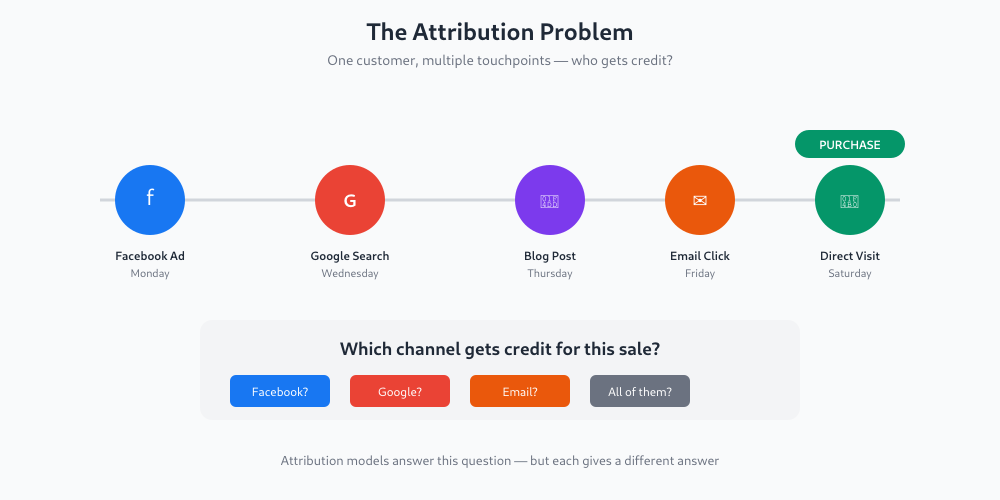
A visitor sees your Facebook ad on Monday. Clicks a Google result on Wednesday. Opens your email on Friday. Then finally buys on Saturday after typing your URL directly.
Which marketing channel gets credit for that sale?
This is the attribution problem—and it’s one of the most debated topics in marketing analytics. Everyone agrees attribution matters. Nobody agrees on how to do it right.
This guide explains what attribution actually is, why it’s genuinely difficult, and how to think about it without getting lost in the weeds.
What Is Marketing Attribution?
Attribution is the process of assigning credit to marketing touchpoints that lead to a conversion. When someone buys your product or signs up for your service, attribution answers: “What marketing efforts contributed to this outcome?”
Simple in theory. Messy in practice.
The problem is that modern customer journeys aren’t linear. According to Forrester Research, B2B buyers now engage with 27+ touchpoints before converting. Even for simpler B2C purchases, people typically interact with a brand multiple times across different channels.
If you’re using UTM parameters to track your campaigns, you’re already collecting the data attribution needs. The question is: how do you interpret that data?
Why Attribution Is Confusing
Attribution gets complicated for three main reasons:
1. Multiple Touchpoints, One Conversion
When a customer interacts with your brand five times before buying, which interaction “caused” the purchase? The first one that introduced them to you? The last one that pushed them over the edge? All of them equally?
There’s no objectively correct answer. Different attribution models give different answers—and each model has reasonable logic behind it.
2. Cross-Device and Cross-Channel Blindspots
Someone sees your Instagram ad on their phone. Later, they search on their laptop and convert. Unless you have sophisticated tracking (and user consent), these look like two different people.
With privacy changes—iOS restrictions, cookie deprecation, ad blockers—connecting the dots across devices and channels has gotten harder, not easier.
3. Correlation vs. Causation
Just because someone saw an ad before buying doesn’t mean the ad caused the purchase. Maybe they were already planning to buy. Maybe they would have found you anyway. Attribution models measure correlation and call it causation—because that’s the best we can do with the data available.
The thing most guides don’t tell you: all attribution models are wrong. Some are useful. The goal isn’t perfect accuracy—it’s consistent, actionable insight.
Single-Touch Attribution Models
The simplest approach: give 100% of credit to one touchpoint. Easy to understand, easy to implement, but obviously incomplete.
First-Touch Attribution
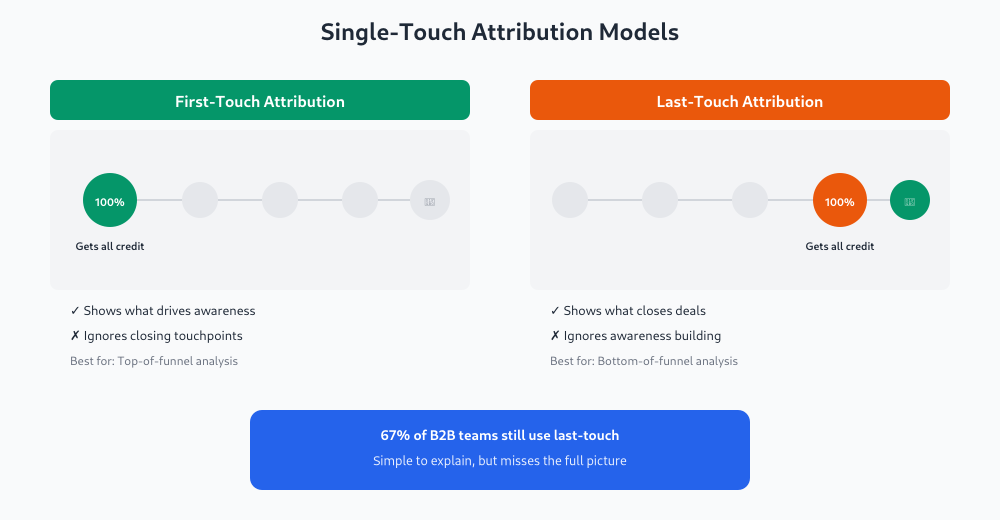
All credit goes to the first interaction. The ad, blog post, or referral that initially brought someone to your site gets full credit for any eventual conversion.
Good for: Understanding what drives awareness. If you want to know which channels introduce new people to your brand, first-touch shows you.
The problem: It ignores everything that happens after that first click. A visitor might discover you through organic search, then convert six months later after an email campaign—but email gets zero credit.
Last-Touch Attribution
All credit goes to the final interaction before conversion. Whatever touched the customer right before they bought gets 100% of the credit.
Good for: Understanding what closes deals. If you want to know which channels push people over the finish line, last-touch shows you.
The problem: It ignores everything that built awareness and consideration. Your brand campaigns and content marketing might be essential, but they’ll show zero conversions if they’re never the last touch.
In 2026, about 67% of B2B marketing teams still use last-touch attribution—mostly because it’s the default in many analytics tools and the easiest to explain to stakeholders.
Multi-Touch Attribution Models
Multi-touch attribution (MTA) distributes credit across multiple touchpoints. More realistic than single-touch, but requires more sophisticated tracking and analysis.
Linear Attribution
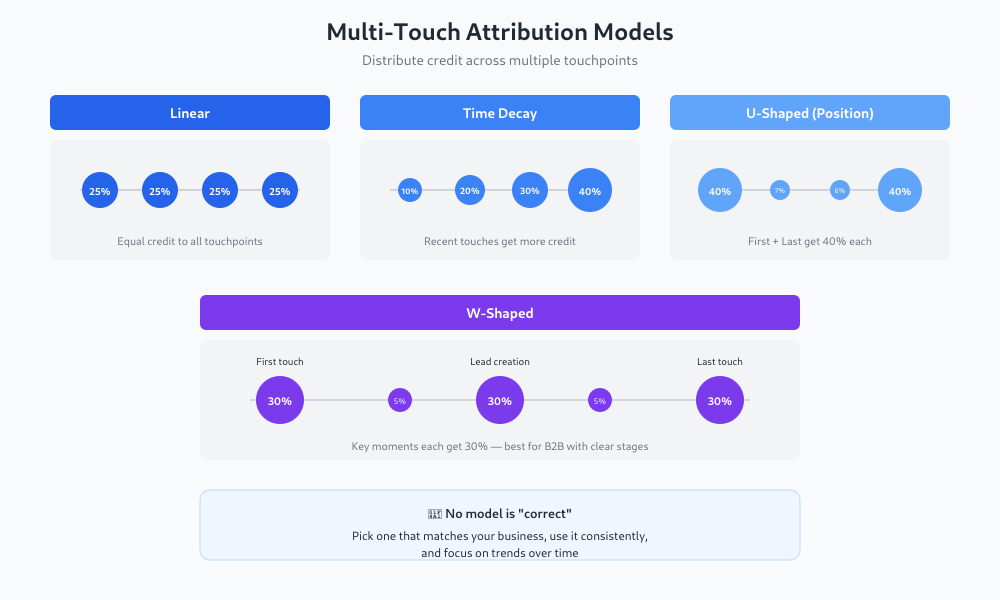
Every touchpoint gets equal credit. If there were five interactions before conversion, each gets 20%.
Good for: Teams that believe every interaction matters equally. Simple and fair.
The problem: Treats a random display ad impression the same as a detailed product demo. Not all touchpoints contribute equally, but linear attribution pretends they do.
Time Decay Attribution
Touchpoints closer to conversion get more credit. The logic: recent interactions have more influence on the final decision than distant ones.
Good for: Short sales cycles where recency matters. The email they opened yesterday probably influenced the purchase more than the blog post they read three months ago.
The problem: Undervalues awareness campaigns. Your top-of-funnel content might be essential for filling the pipeline, but time decay will always favor bottom-of-funnel touchpoints.
Position-Based (U-Shaped) Attribution
The first and last touchpoints each get 40% credit. The remaining 20% is split among middle interactions.
Good for: Balancing awareness and conversion. Recognizes that introducing someone to your brand and closing the deal are both critical moments.
The problem: The 40/40/20 split is arbitrary. Why not 30/30/40? There’s no data-driven reason for these specific percentages.
W-Shaped Attribution
Three key moments each get 30%: first touch, lead creation (like a form submission), and last touch. The remaining 10% goes to other touchpoints.
Good for: B2B companies with clear lead generation stages. Recognizes that the middle of the funnel matters too.
The problem: Assumes every journey has a clear “lead creation” moment. Not all businesses or customer paths fit this model.
Which Model Should You Use?
Here’s my honest take after working with dozens of clients on this question:
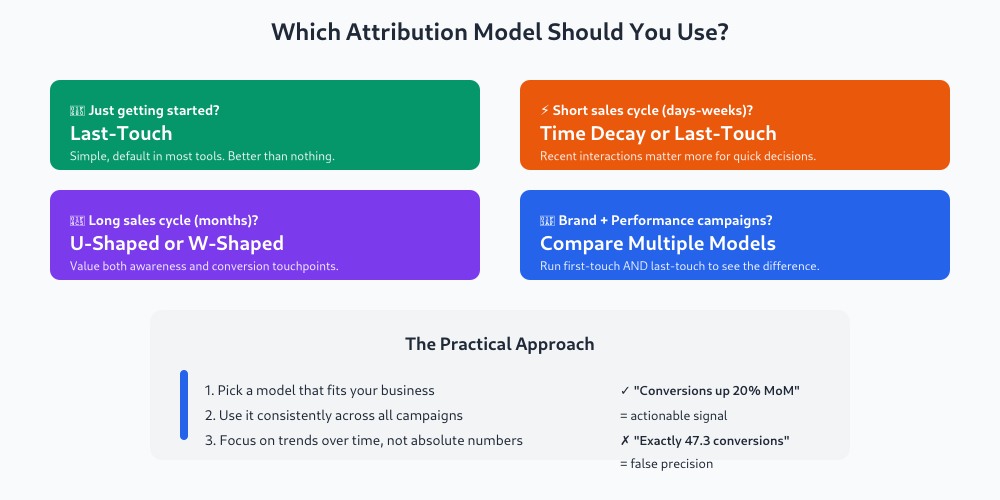
If you’re just getting started: Use last-touch. Yes, it’s flawed. But it’s better than no attribution, and it’s what your analytics tool probably defaults to. You can get more sophisticated later.
If you have a short sales cycle (days to weeks): Time decay or last-touch works reasonably well. Recent interactions genuinely matter more for impulse or considered purchases.
If you have a long sales cycle (months): Position-based or W-shaped makes more sense. You need to value both awareness and conversion activities, or you’ll underinvest in top-of-funnel.
If you’re running brand campaigns alongside performance campaigns: Consider running multiple models in parallel. Compare how campaigns look under first-touch vs. last-touch. The difference reveals which channels drive awareness vs. conversion.
What I’ve seen work best: don’t obsess over finding the “right” model. Pick one, use it consistently, and focus on trends over time rather than absolute numbers. If a campaign’s attributed conversions are growing month over month, that’s signal—even if the exact number is imprecise.
The Bigger Picture
Attribution is one piece of understanding marketing effectiveness, not the whole picture. It works best alongside:
- Incrementality testing — Actually running experiments to measure whether a channel causes conversions (not just correlates with them)
- Marketing mix modeling — Statistical analysis of how budget allocation across channels affects overall results
- Qualitative feedback — Asking customers “how did you hear about us?” (simple, imperfect, but useful)
Attribution tells you how credit flows through your tracking system. It doesn’t tell you ground truth about what caused a purchase—because that’s unknowable.
The practical approach: use attribution to make directional decisions. If a channel consistently shows poor performance across multiple attribution models, that’s a signal. If a campaign looks great under first-touch but terrible under last-touch, you’ve learned something about its role in the funnel.
Getting Started
If you’re feeling overwhelmed, start simple:
- Get your tracking right first. Attribution is meaningless without good data. Make sure you’re tagging campaigns consistently and tracking the conversions that matter.
- Look at both first and last touch. Most analytics tools can show you both. Compare them—the gap between the two tells you how long and complex your customer journeys are.
- Focus on trends, not absolutes. Month-over-month changes in attributed conversions matter more than the exact number.
- Don’t let attribution paralyze you. Some marketers spend so much time debating models that they never actually improve their campaigns.
Attribution is confusing because marketing is confusing. Customers take messy, non-linear paths to purchase. No model perfectly captures that reality. The goal is to get close enough to make better decisions—not to achieve perfect measurement.
And honestly? If you’re even thinking about attribution, you’re ahead of most marketers who just look at last-click and call it a day.